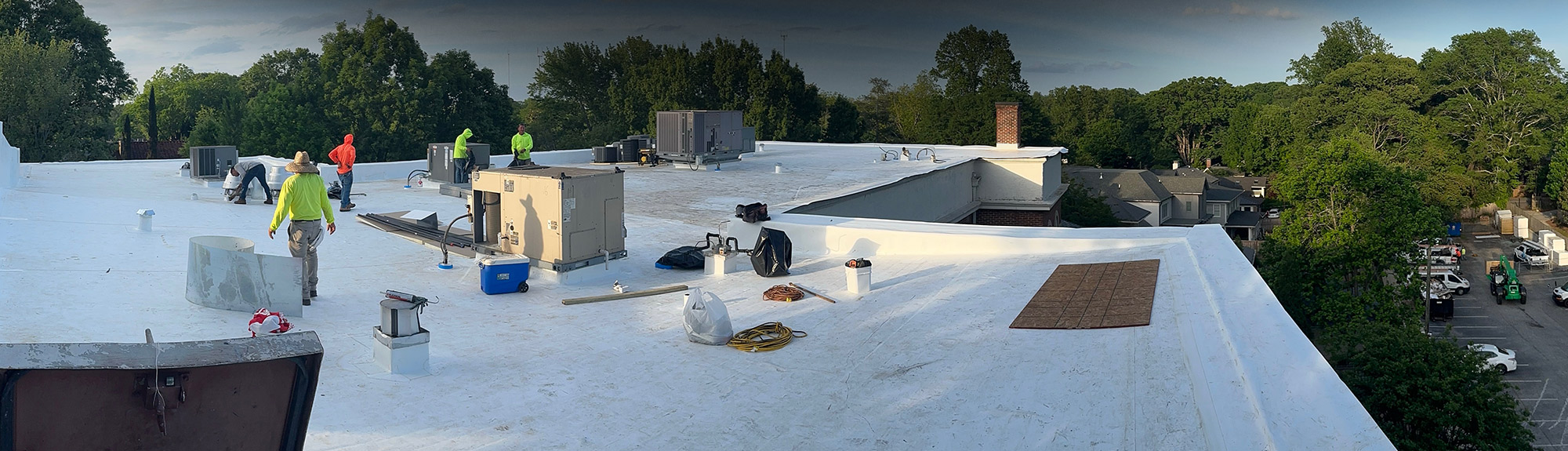
Commercial Roofing Systems
Our commercial roofing experts offer a variety of services, including installation, replacement, repair and maintenance. When it’s time for a new roof, Brazen Roofing can help you choose the right material for your structure. Modern commercial roofing materials are designed to reflect sunlight and withstand the impact of wind, rain, debris and hail.
Metal roofs
Whether Steel or Aluminum, metal roofs are incredibly sturdy and last a long time, sometimes up to fifty years. Another advantage of metal roofs is that they’re more fire resistant than other options. Metal roofs also keep buildings cooler because of the great insulation they provide.
TPO Roofing
Thermoplastic Polyolefin, or TPO, is a cost-effective solution that’s great for commercial businesses. It’s white color helps reflect heat away from the building, helping to lower HVAC costs. Because it’s light weight, it’s easier to install than metal roofs so it’s a great fit for someone looking for an effective, cheaper roofing system with durability up to 25 years when it’s installed correctly.
PVC Roofing
Polyvinyl Chloride, or PVC, is another cost-effective solution for commercial roofing. It’s almost identical to TPO with its main differences being that PVC is more flexible, has a different chemical make-up and has been around longer than TPO. Otherwise, both a white to reflect heat, have similar characteristics and last 25 years.
EPDM Roofing
Ethylene Propylene Diene Terpolymer, or EPDM is a synthetic rubber membrane that is most commonly used on commercial buildings. It’s extremely durable and is compared as being a bulletproof rubber roof that lasts slightly longer than TPO or PVC at 25-30 years.
Liquid Applied Roofing
A liquid-applied roofing system is an efficient solution for renewing and protecting your existing roof. It forms a seamless, watertight layer that guards against UV exposure and helps your roof last longer, all without the downtime of a full replacement.
Shingle Roofing
Shingle roofing is a versatile and cost-effective choice for commercial properties with sloped roof designs. Available in a wide range of colors and styles, modern asphalt shingles provide reliable protection from wind, rain, and UV exposure while adding curb appeal and long-term value.
Explore our system options, including Roof Coatings, the GAF Commercial System, and Shingle Roofing. This service is part of our full Commercial Roofing line.
Read Up on Each System
- Commercial metal roofing systems, standing seam and PBR panels
- TPO roofing, reflective, heat-welded, the default on new low-slope work
- PVC roof systems, the correct membrane wherever grease or chemical exhaust reaches the roof
- EPDM roofing, long field record, cold-climate performance, easy to repair
- Liquid-applied roofing, restoration without a tear-off
- Commercial shingle roofing: sloped commercial, multifamily and HOA work
- Roof coatings, extending a sound roof at roughly half the cost of replacement
- The GAF commercial system
How to Choose Between Them
Six questions decide it, and the building answers most of them. If a contractor recommends a system before asking these, they are selling what is on the truck.
- What comes out of the roof? Kitchen grease or chemical exhaust rules out TPO and points straight at PVC. Animal fats degrade TPO, and the failure is not gradual. This one question overrides every other consideration.
- How does water leave the roof? More flat roofs fail from ponding than from membrane defects. If there is standing water, the answer involves tapered insulation, crickets or additional drains before it involves a membrane.
- How much foot traffic does it take? Regular HVAC service and equipment access favor modified bitumen, reinforced membranes and a proper walkpad plan.
- What is the climate? Reflectivity earns real money in Myrtle Beach, Savannah, Jacksonville and Oklahoma City. In Denver and Springfield, cold-weather flexibility and hail resistance matter more.
- What is the wind exposure? Attachment pattern, perimeter enhancement and edge metal are engineered, not chosen. On the coast this is the most consequential decision in the assembly.
- How long are you holding the building? A five-year hold and a twenty-year hold justify different roofs, and we will say so rather than always quoting the better one.
Replace, Restore or Repair?
Before picking a membrane, settle whether you need one. On an aging roof this is answered with core samples and an infrared scan, not a walkthrough, because whether the insulation underneath is dry decides everything downstream.
- Repair when the membrane is sound and the defects are isolated at curbs, seams, penetrations or edge metal. See commercial repairs.
- Restore or coat when the membrane is aging but intact and the insulation is dry, roughly half the cost of replacement, no tear-off, minimal disruption.
- Replace when the insulation is wet, the membrane is failing broadly, or two roofs are already in place. See commercial roof replacement.
Coating over saturated insulation seals the water in and lets the deck keep deteriorating out of sight. It looks like a solved problem for about three years, which is why we take cores rather than quoting off a photograph.
What Separates Two Quotes on the Same Building
The system name on a proposal tells you very little. These are the lines that differ, and they are where a lower bid usually comes from:
- Membrane thickness, specified in mils, the easiest place for a bid to be quietly cheaper
- Insulation R-value, and whether it meets current energy code
- Attachment method: mechanically fastened, fully adhered or ballasted
- Perimeter and corner enhancement, and the edge metal specification
- Flashing detail at curbs, drains, parapets and penetrations: where commercial roofs actually fail
- Seam probe testing, and whether it is in the scope
- Warranty tier, and whether it is material-only or includes labor
Read our installation process for how we handle each of those,.
Where We Work
Commercial roofing across all twelve markets: Myrtle Beach, Charleston, Savannah, Raleigh, Jacksonville, Denver and Parker, Oklahoma City and Springfield: that is South Carolina, North Carolina, Georgia, Florida, Colorado, Oklahoma, Missouri, Wisconsin, Ohio, Kansas and Tennessee. Full list on our service area page.
Whatever system goes on, it reaches its rated life only if it is inspected and maintained, which most manufacturer warranties require anyway. See our preventative maintenance program and how often a commercial roof should be inspected. Examples of completed work are in our commercial roof work.
Frequently Asked Questions
There is no best system in the abstract, the building decides. Grease or chemical exhaust means PVC. New low-slope construction usually gets TPO for its reflectivity and welded seams. Cold climates and repairability favor EPDM. Regular foot traffic favors modified bitumen. Sloped sections get metal or shingle.
Roughly 25 years for TPO and PVC, 25 to 30 for EPDM, and up to about 50 for metal. Those are ranges, not promises: drainage, membrane thickness, attachment and maintenance move a given roof a long way within them.
Often, yes. If the membrane is aging but intact and the insulation underneath is dry, a coating or liquid-applied restoration runs about half the cost of replacement with no tear-off. Core samples and an infrared scan are how anyone confirms the insulation is dry, a visual inspection cannot.
Both are white reflective single-ply membranes with heat-welded seams and similar service life. PVC is more flexible, has been in use longer, and resists grease and chemicals, which makes it the required choice over restaurants and any building with chemical exhaust. TPO costs less and suits everything else.
Usually membrane thickness, insulation R-value, attachment method, perimeter enhancement and warranty tier: not labor. A quote can be meaningfully cheaper by specifying thinner material and a shorter warranty, and that difference is invisible unless you compare those lines directly.
Yes, and that is the normal case. We tear off only what can be made watertight the same day, and staging, deliveries and work hours are agreed before mobilization. Most of our commercial customers do not close for a day.