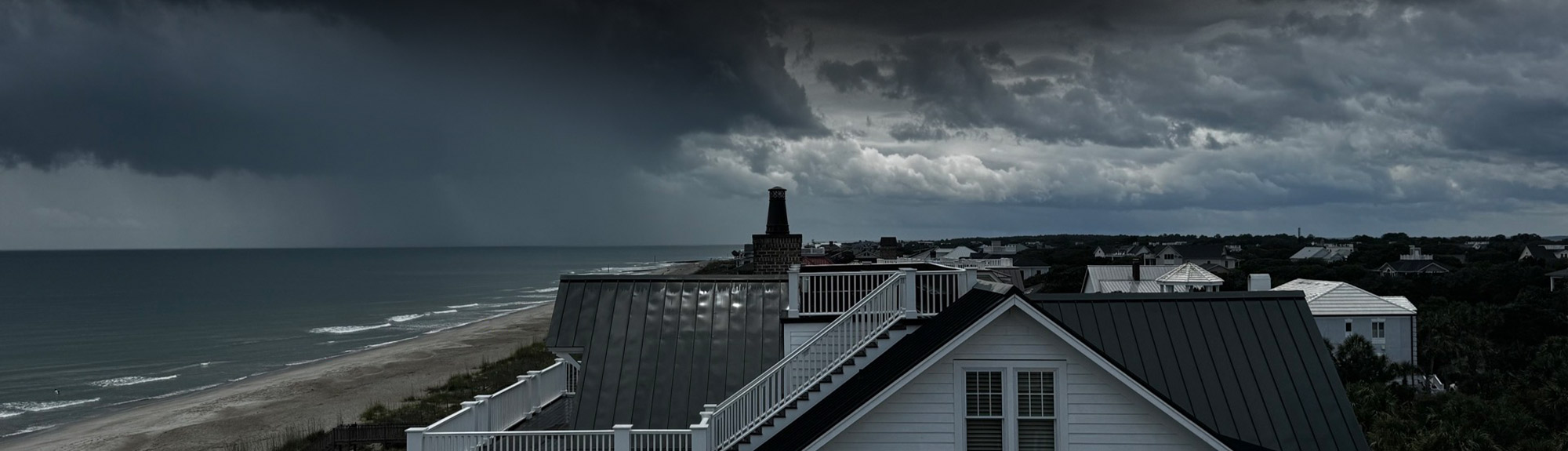
Storm Restoration
What storm damage restoration involves
Severe weather doesn’t wait for a convenient time, and neither do we. Storm damage roof restoration means inspecting, documenting, and repairing damage caused by wind, hail, hurricanes, or heavy rain, and getting your home or business back to full protection as fast as possible.
Brazen Roofing’s storm restoration teams respond quickly across every market we serve, from hurricane-prone coastal communities like Myrtle Beach to hail-heavy inland markets like Oklahoma City. We inspect the full roof system, document the damage with photos for your insurance claim, and walk you through repair or replacement options so you’re never guessing what happens next.
How we work with your insurance
Because we work with insurance adjusters every day, we know exactly what a claim needs to move forward. Our Insurance Guide walks you through the process step by step, and if your roof needs attention right now, our emergency repair team can respond immediately.
- We respond fast after severe weather, with priority scheduling for storm-damaged roofs
- Our inspections are documented and insurance-ready from day one
- We handle wind, hail, hurricane, and heavy-rain damage across every market we serve
Where we respond
We provide storm damage roof restoration across our full service area, including Myrtle Beach, Charleston, Savannah, Raleigh and Jacksonville on the coast, and Denver, Oklahoma City, Springfield, Wichita, Columbus, Milwaukee and Knoxville inland. See it in action locally: Hurricane Damage Restoration in Myrtle Beach and Storm Restoration & Insurance Claims in Oklahoma City. Newer markets have their own claims pages too: Milwaukee, Columbus and Wichita.
Think your roof has storm damage? Contact Brazen Roofing today for a free storm damage inspection.
What storm damage actually looks like
The damage that costs you money is rarely the damage you can see from the driveway. Four types, and they present differently:
- Wind. Wind can break the adhesive seal under a shingle and set it back down, so the roof looks untouched while that shingle is no longer bonded. It lifts in the next moderate blow. Damage starts at edges, corners and ridges rather than in the middle of the roof.
- Hail. Hail bruises the mat beneath the granule surface without necessarily cracking anything visible. The bruise becomes a crack months later under normal thermal cycling. Check gutters and downspout splash zones for washed-out granules, and look at soft metal: vents, flashing and gutters dent before shingles show anything.
- Hurricane and tropical systems. Sustained wind plus driving rain pushed sideways and uphill beneath shingles, which ordinary rain never does. Coastal markets see this without a direct landfall.
- Impact and tree fall. Obvious when a limb is through the roof, less so when a branch has scraped granules off a slope or cracked a ridge cap on the way down.
Two of those four are effectively invisible from the ground. That is the entire reason a post-storm inspection is worth doing even when the roof looks fine.
What to do first, in order
- Wait until it is safe. No ladders in wind or rain, nothing near a downed line, and do not get on the roof, a storm-damaged roof is structurally unpredictable and walking it causes fresh damage that then becomes hard to attribute to the storm.
- Photograph everything, dated. Wide shots showing which elevation you are looking at, close shots of anything specific, and the granules in your gutters.
- Check inside. Ceilings, the tops of walls, and the attic with a flashlight for damp insulation, staining on the underside of the decking, or daylight at a penetration.
- Report to your insurer promptly, even if you are unsure of the extent.
- Get a documented inspection before you accept that there is no damage.
- Do not sign anything under pressure. Not that day, and not on a doorstep.
Our post-storm roof checklist walks through the homeowner side of this in detail, and it applies well beyond Florida.
How the claim process runs
Claims are decided on evidence, not on opinion. The sequence is consistent:
- Inspection and documentation. We photograph and record the condition of the whole roof, not only the obvious damage.
- Written scope. A detailed scope of work you can put in front of an adjuster.
- The adjuster visit. We meet your adjuster on site and walk the roof together, so both parties are looking at the same evidence.
- Supplements where needed. Where an adjuster’s scope misses items, those are raised through the proper channel rather than argued about afterwards.
- The work. Sectioned, dried in the same day, and inspected on completion.
Our insurance guide covers the process in more depth, and insurance-funded versus self-funded replacement is worth reading before you file, because a claim is not automatically the right route on a smaller job.
A word about post-storm contractors
Every significant hail or wind event draws crews from out of state. Some are legitimate operations scaling up; some will be gone in weeks, along with any warranty they offered. Two things are worth doing before you sign anything: verify the license and insurance directly with the issuing authority and the insurer, and read local roofer versus storm chaser.
One point in particular: be very cautious about anyone offering to cover, absorb or waive your deductible. Your deductible is your obligation to your insurer, many states prohibit the practice, and the exposure on a misrepresented claim falls on you rather than on them.
Storm damage questions
As soon as it is safe. Wind and hail damage is frequently invisible from the ground, and the sooner it is documented the easier it is to tie to the storm that caused it. Carriers scrutinize late claims harder, and damage left through another season is harder to attribute.
Probably yes. Wind can break the seal beneath a shingle and set it back down so it appears intact, and hail can bruise the mat without cracking the surface. Neither shows from the ground, and both leak later.
No. A storm-damaged roof is structurally unpredictable, wet surfaces are dangerous, and walking on compromised shingles causes fresh damage that becomes difficult to attribute to the storm. Everything a homeowner needs to see can be seen from the ground, a window, or the attic.
Yes. We inspect and document the damage, provide a detailed written scope, and meet your adjuster on site to walk the roof together. What we do not do is take over your claim or ask you to sign away your policy rights.
Dated wide shots showing each elevation, close shots of anything specific, granules in the gutters and downspout splash zones, dents in soft metal such as vents and flashing, and any interior staining. If you have images of the roof from before the storm, keep them in the same folder.
All eleven: Myrtle Beach, Charleston, Savannah, Raleigh, Jacksonville, Denver and Parker, Oklahoma City, Springfield, Milwaukee, Columbus, and Wichita. Coastal markets see hurricane and wind-driven rain; the inland markets see hail and straight-line wind.