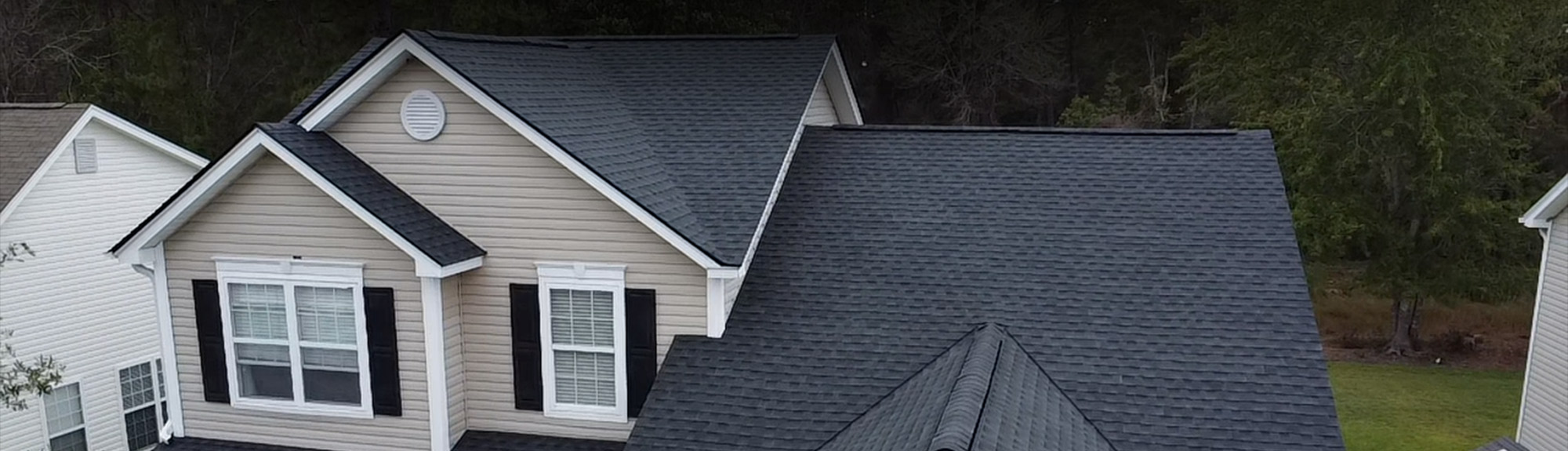
Residential Roof Replacement
When it’s time for a roof replacement, Myrtle Beach homeowners need more than just new shingles. They need a roof built to handle coastal wind, salt air, and hurricane season. Our residential roof replacement service uses materials and installation methods that hold up to exactly that.
Every replacement starts with a full inspection of your existing roof and decking. That way, we know what we’re working with before a single shingle comes off. From there, we walk you through material options, timeline, and cost, so there are no surprises once the crew is on your roof.
We’ve replaced roofs across Myrtle Beach and the surrounding Grand Strand for years. We know what holds up here and what doesn’t. That local experience shows up in the details: proper underlayment, secure flashing, and a finished roof that’s ready for whatever the coast throws at it.
- Free inspection and roof replacement estimate
- Materials chosen for coastal wind and moisture resistance
- Local Myrtle Beach crew who know what holds up on the Grand Strand
This is part of our full Residential Roofing service line. Myrtle Beach homeowners can also count on us for Commercial Flat Roofing and Hurricane Damage Restoration. See finished results in our Myrtle Beach project gallery.
Ready for a new roof? Contact Brazen Roofing for a free Myrtle Beach roof replacement estimate.
What the Grand Strand Does to a Roof
- Salt air. It attacks the metal rather than the asphalt: fasteners, flashings, valley metal, vent collars and drip edge corrode long before the field shingles look worn. A coastal roof often reaches a point where the shingles are serviceable and the connections are not, which is exactly what wind exploits.
- Wind with no windbreak. Uplift concentrates at eaves, rakes and ridges. Most architectural shingles reach their rated wind speed only when installed to the enhanced nailing pattern, a condition of the rating rather than an upgrade.
- Heat and humidity. Sustained heat drives the oils out of asphalt so the shingle stiffens and cracks instead of flexing. Attic ventilation moves that outcome more than the brand of shingle does.
- Wind-driven rain. The coastal failure mode people underestimate. Water pushed sideways defeats details that handle vertical rain perfectly well.
- Algae streaking on north-facing planes, which is why algae-resistant shingles are worth specifying here.
The Decking Inspection Is Not a Formality
Every replacement starts with a full inspection of your existing roof and decking, and on the Grand Strand that inspection earns its keep. Humidity, a hot attic and a slow flashing leak produce soft or delaminated sheathing, and it is invisible until the old roof comes off.
It matters beyond the repair cost: compromised sheathing will not hold a nail properly, which quietly undoes the wind rating you are paying for. Everything we find is photographed and priced before it gets covered back up.
What We Specify Here
- Architectural shingles installed to the enhanced nailing pattern. See architectural and designer shingles.
- Sealed starter strip at eaves and rakes. On a coastal roof this matters as much as the field shingle, it is where wind gets underneath.
- Corrosion-appropriate fasteners and flashing metal. The specification that decides how long the roof stays attached, and the easiest thing for a cheaper bid to skip invisibly.
- Algae-resistant shingles.
- Synthetic underlayment, with a secondary water barrier where warranted.
- New flashing at every wall, chimney, skylight and valley: replaced, not reused, plus kickout flashing and new pipe boots.
- Balanced ventilation, corrected while access is open. See why proper roof ventilation matters and roof ventilation in South Carolina.
Metal is worth pricing here too, it handles wind and salt well and lasts two to three times as long. See metal roofs and GAF TimberSteel.
If You Are Not Local
A large share of Grand Strand roofs belong to second-home and rental owners who are not here during the work. That changes what a good job looks like: photographs at every phase, sent as standard rather than on request, and a written record of what was found on the deck before it was covered.
It is the thing our customers mention most in reviews, and it is not a favor, it is how the job should be run when the owner cannot walk out and look.
What the Week Looks Like
- Inspection and written scope: material options, timeline and cost before anything starts.
- Protection of landscaping, driveway, pool and anything below the eaves.
- Tear-off in sections, never more open than can be made watertight the same day. In summer the afternoon forecast drives the daily plan.
- Deck repair as found, photographed and priced.
- Dry-in, flashing, ventilation corrections, then field shingles.
- Nail sweep and cleanup every evening.
- Quality-control inspection by Brazen staff rather than the installing crew, then warranty registration filed by us.
Hurricane season runs 1 June to 30 November. If the roof is already failing it gets done whenever it needs doing, with the daily plan built around the forecast. If it can wait, outside the peak is easier on everyone.
More about us here on our Myrtle Beach roofing page and our service area. See hurricane damage restoration for storm work, the general roof replacement process, financing, or start with a free roof inspection.
Frequently Asked Questions
Less than the same roof would last inland. Heat drives the oils out of asphalt shingles, an under-ventilated attic cooks them from underneath, and salt air degrades the metal holding everything down. Ventilation affects the outcome more than the brand of shingle does.
Not the shingles so much as the metal holding them on: fasteners, flashings, valley metal, vent collars and drip edge. A coastal roof often reaches a point where the shingles look serviceable and the connections do not, which is exactly the condition wind exploits.
It gets photographed, priced and shown to you before anything covers it back up. It matters beyond the repair cost: compromised sheathing will not hold a nail properly, which undoes the wind rating you are paying for.
It is a large share of what we do here. Photographs at every phase are standard rather than on request, along with a written record of what was found on the deck before it was covered, because you cannot walk out and look.
If it is near the end of its life, yes. The work that actually holds up in a storm is the enhanced nailing pattern, sealed starter courses at eaves and rakes, and flashing replaced rather than reused. If the roof is already failing we do the work whenever it needs doing and build the daily plan around the forecast.
It is worth pricing. Metal handles coastal wind and salt well and lasts two to three times as long as asphalt, so divided by years of service the gap narrows considerably. Near salt water, fastener and flashing metallurgy has to be specified properly on any material, including shingles.