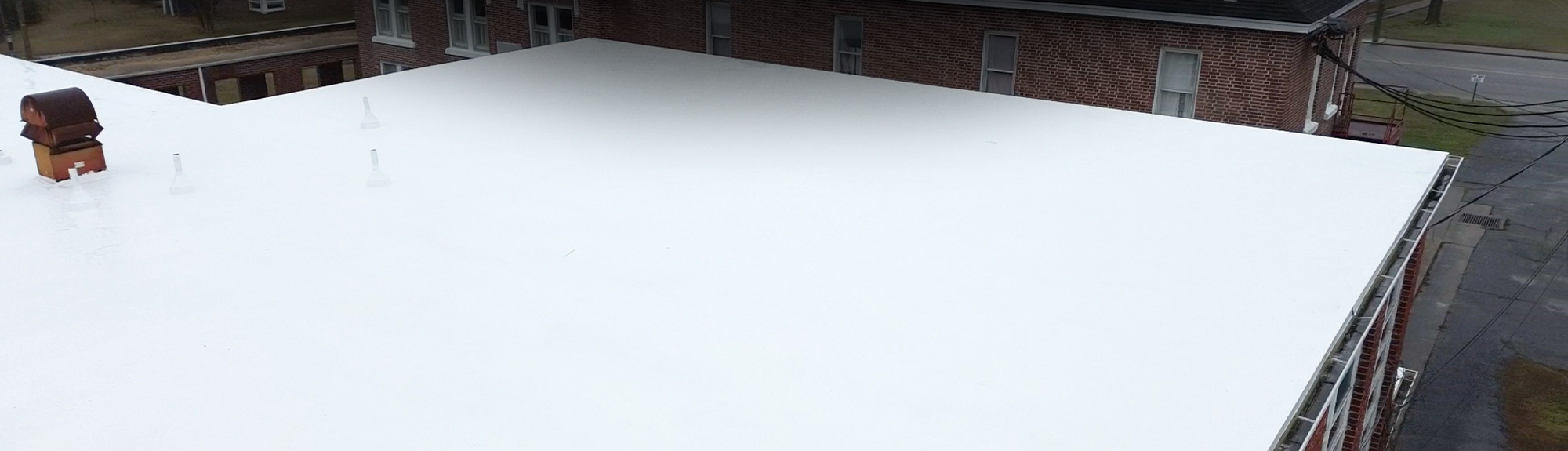
Commercial Flat Roofing
Flat and low-slope commercial roofs face a different set of problems than pitched residential roofs. The big ones are standing water and UV breakdown over a wide open surface. Our commercial flat roofing service in Myrtle Beach covers installation, repair, and coatings built to handle exactly that.
We work with the systems that perform best on flat commercial roofs: TPO, EPDM, and modified bitumen. We also size drainage and seams to actual Myrtle Beach rainfall, not a generic spec sheet. That’s the difference between a flat roof that holds water and one that doesn’t.
Whether you’re managing a strip mall, warehouse, or office building, downtime costs money. We plan installs and major repairs around your business hours where we can. Once your new roof is in, our preventative maintenance program helps protect that investment year after year.
- TPO, EPDM, and modified bitumen installation and repair
- Drainage and seam work sized for Myrtle Beach rainfall, not guesswork
- Scheduling built around minimizing disruption to your business
Got a flat roof that needs attention? Contact Brazen Roofing for a free commercial roof inspection. This is part of our full Commercial Roofing service line. Myrtle Beach property owners can also count on us for Residential Roof Replacement and Hurricane Damage Restoration. See completed work in our Myrtle Beach project gallery.
What the Grand Strand Does to a Flat Roof
Myrtle Beach is the harshest commercial roofing environment we work in, and it is harsh in four ways at once.
- Hurricane season, June through November. A wide flat roof is a wing. Uplift concentrates at the perimeter and the corners, which is why edge metal and perimeter attachment matter more than anything happening in the field of the roof. Direct landfalls on the Grand Strand are relatively rare; consequential wind and multi-day rain events are not.
- Salt air, continuously. Not the membrane: the metal. Fasteners, termination bars, edge metal, drain clamping rings, coping and rooftop equipment corrode steadily. An older coastal commercial roof has usually lost strength in its connections rather than its membrane, and connections are what wind pulls on.
- Rainfall volume and intensity. Horry County takes over 50 inches a year, much of it in violent summer downpours. Drainage designed for steady rain ponds under a Grand Strand thunderstorm.
- Heat and humidity. Long summers, a membrane that never fully dries, and real cooling load on any dark surface. Reflectivity earns its cost here in energy alone.
The cumulative pattern matters more than any single storm. Roofs here rarely fail in one event: each storm works a little more edge metal loose and opens another lap. They fail in the fourth one, by which point attributing it to a single storm is difficult.
Buildings We Work On Along the Coast
Commercial flat roofing across Horry County and the Grand Strand: Myrtle Beach, North Myrtle Beach, Surfside Beach, Garden City, Murrells Inlet, Socastee, Carolina Forest, Conway, Little River and Loris.
- Hospitality. The defining building type here, and the hardest scheduling problem in commercial roofing. Occupied hotels and resorts cannot have open roof work overhead, and the work has to happen around occupancy rather than around our calendar. Shoulder season is the honest answer for a hotel replacement.
- Restaurants. The Grand Strand has an extraordinary density of them, and grease exhaust degrades TPO and EPDM. PVC is the specification, not a preference: and exhaust fans spread grease much further across a roof than owners expect, so the whole roof is in the exposure zone.
- Retail and strip centers. Multiple tenants, multiple HVAC curbs, and the source of most leak calls we get.
- Condo and resort associations. Shared decisions, harder scheduling, and buildings taking the full brunt of salt air. See multifamily and HOA roofing.
- Warehouse and light industrial inland toward Conway, where the economics of a coating restoration versus replacement are worth running properly before anything comes off.
- Office and medical. Occupied buildings where sequencing is the whole job.
Repair, Coat or Replace, and How We Decide
The only question that matters on an aging flat roof, and it is answered with core samples and a moisture survey rather than by looking at it.
- Repair when the membrane is sound and the problem is isolated, open laps, failed fasteners, a bad curb flashing, lifted edge metal. See commercial repairs.
- Coat or restore when the membrane is aging but intact and the insulation is dry. Roughly half the cost of replacement, no tear-off, and a hotel stays open. See liquid-applied roofing.
- Replace when the insulation is wet, the membrane has widespread splits or shrinkage, or there are already two roofs in place. See commercial roof replacement.
We use infrared scanning to map where moisture has actually traveled before cutting anything. Coating over saturated insulation seals the water in and lets the deck corrode out of sight, on the coast, with salt already in the assembly, that is a worse gamble than it is anywhere else. Read what to expect during a commercial roof inspection.
Membrane Choices for Coastal Buildings
- TPO: reflective and heat-welded, the default on new low-slope work here. The reflectivity is worth real money through a Grand Strand summer.
- PVC: required over restaurants and any building with grease or chemical exhaust. Given the restaurant density here, this comes up constantly.
- EPDM: long field record and easy to repair, though the dark surface works against you in this heat unless it is coated.
- Modified bitumen, multi-ply redundancy and the most forgiving system under regular foot traffic.
- Standing seam and PBR metal: for the sloped sections most coastal commercial buildings have, with fastener and flashing metallurgy specified for salt air rather than assumed.
Whatever the membrane, the coastal decision that matters most is attachment. Fully adhered outperforms mechanically fastened under uplift, perimeter and corner enhancement is not an upgrade, and edge metal has to be engineered for the wind zone. That is where coastal roofs fail, every time.
Before Hurricane Season
The cheapest commercial roof work in Myrtle Beach happens in May. Clear the drains, secure loose edge metal, check every curb, coping and penetration, and photograph the roof so you have a documented before-condition if you end up filing a claim. Our guide to preparing a commercial roof for hurricane season has the checklist.
If a storm has come through, get it documented early rather than waiting on the carrier, roofs assessed in week one settle very differently from roofs assessed in month three. Start at storm restoration and see how to check for roof damage after a hurricane. Note also that many South Carolina commercial policies carry a separate named-storm deductible calculated as a percentage of insured value rather than a flat figure, and most separate wind damage from flood. Read those two clauses before you need them.
Keeping It Working
Flat roofs on the coast reward maintenance more than anywhere. The two visits worth scheduling are pre-season in May and post-season in December, and the salt-exposed metal is what deserves the attention: fasteners, terminations, coping and drain hardware. Our preventative maintenance program covers it, which most manufacturer warranties require anyway. See how often a commercial roof should be inspected and why roof maintenance is essential for your business.
Myrtle Beach is our oldest and largest operation, more about Brazen here on our Myrtle Beach roofing page, and read what our customers say. See examples in our commercial roof work, our installation process, or the full Commercial Roofing line. For storm work specific to this market see hurricane damage restoration.
Frequently Asked Questions
Less than the same roof inland, and the limiting factor is usually the metal rather than the membrane. Salt air corrodes fasteners, terminations, edge metal and drain hardware continuously, so an older coastal roof has often lost strength in its connections, which is exactly what wind pulls on.
Attachment and edge detail. Uplift concentrates at perimeters and corners, so fully adhered membranes outperform mechanically fastened ones, perimeter enhancement is not an upgrade, and edge metal has to be engineered for the wind zone. Wind failures start at the edge, every time.
Yes, and it is most of what we do here. Work is sequenced so no more roof is open than can be made watertight the same day, with staging and deliveries agreed before mobilization. For a full hotel replacement, shoulder season is the honest recommendation.
PVC. Kitchen exhaust deposits animal fats that degrade TPO and EPDM, and exhaust fans spread grease much further across the roof than owners expect, so the whole roof is in the exposure zone, not just the area near the hood.
Coat it if the membrane is aging but intact and the insulation underneath is dry: about half the cost of replacement, no tear-off, and the building stays open. Replace it if the insulation is wet or the membrane is failing broadly. Core samples and infrared scanning answer this, and on the coast coating over wet insulation is a worse gamble because salt is already in the assembly.
Twice a year: May, before hurricane season, and December, to see what the season did. Both visits should focus on the salt-exposed metal (fasteners, terminations, coping and drain hardware) as much as on the membrane.