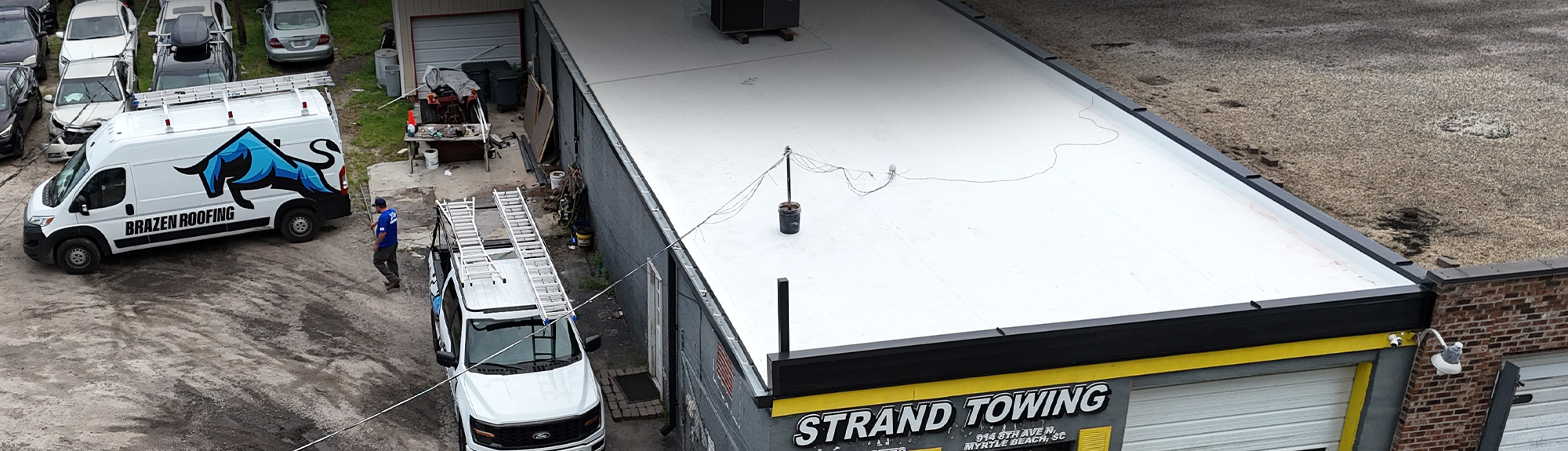
TPO
Thermoplastic Polyolefin (TPO) is one of the most cost-effective and energy-efficient roofing solutions for commercial buildings. With its white, reflective surface, TPO helps reduce heat absorption and lower HVAC costs, keeping your building cooler and more comfortable.
Lightweight and easier to install than many other systems, TPO is an excellent choice for businesses looking for performance and affordability in one package. When properly installed and maintained, TPO roofs deliver reliable protection for up to 25 years.
If you’re looking for a cost-effective commercial roofing solution that delivers energy savings and dependable protection, reach out to our team to learn more about TPO roofing systems and what they can do for your property.
Why TPO Became the Default
TPO is the most specified single-ply membrane on new low-slope commercial construction, and the reason is a combination of three things rather than any one of them: a reflective white surface, hot-air-welded seams, and a price point below PVC.
The welded seam is the part worth understanding. TPO seams are fused with hot air rather than glued, which produces a bond as strong as the sheet itself. Most single-ply leaks originate at seams, so a system whose seams are welded rather than adhered removes the most common failure mode, provided the welding was done correctly, at the right temperature, on a clean surface.
Where TPO Performs Best
- Hot, sunny markets. The reflective surface pays for itself in cooling load in Myrtle Beach, Savannah, Jacksonville and Oklahoma City. On a dark membrane, rooftop surface temperature in July is dramatically higher than on white TPO, and that heat is working against your HVAC all afternoon.
- Large, uninterrupted roofs. Warehouse, distribution and industrial buildings, where wide sheets and long welded seams make the install efficient.
- New construction. Where the deck, slope and insulation can all be specified together rather than worked around. See commercial new construction.
- Buildings with an energy target. Reflectivity is a measurable contribution, and it is the easiest energy improvement on a commercial building because it happens on a roof you were replacing anyway.
Where TPO Is the Wrong Choice
Worth being direct, because TPO gets specified by default on buildings it does not suit.
- Restaurants and anything with grease exhaust. Animal fats degrade TPO. This is what PVC exists for, and it is not a close call.
- Buildings with chemical exhaust. Same reasoning, check the specific chemistry against the manufacturer’s compatibility data before anyone orders material.
- Roofs with standing water. No membrane is happy under permanent ponding. Fix the drainage or accept a shorter life, and consider a coating or liquid-applied system instead.
- Very cold-climate roofs with heavy repair history. EPDM is more forgiving to patch in cold weather and has a longer field record.
Thickness, Installation and What Separates a 12-Year TPO From a 25-Year One
The same product name covers a wide range of outcomes. When you compare two TPO quotes, these are the lines that actually differ:
- Membrane thickness. Usually specified in mils. Thinner material is cheaper and does not last as long, and it is the easiest place for a bid to be quietly lower than a competitor’s.
- Attachment method. Mechanically fastened, fully adhered or ballasted. This affects wind performance, seam stress and how the roof behaves in a storm.
- Insulation and R-value. Current energy code often requires more than what is coming off, which changes assembly height and every detail that ties into it.
- Perimeter and corner enhancement. Wind uplift concentrates at the edges. Enhanced fastening there is not optional on a coastal building.
- Edge metal. Wind failures start at the edge, every time.
- Welding quality control. Probe testing of seams should be part of the job. Ask whether it is.
Our own quality-control inspector signs off on the welds and the details rather than the crew that installed them. Read more about our commercial installation process.
Maintaining a TPO Roof
TPO is low-maintenance, not no-maintenance. The reflective surface picks up dirt, which reduces reflectivity over time and is worth cleaning. Seams and terminations should be inspected annually, drains kept clear, and any work by another trade on the roof checked afterward, HVAC technicians are the most reliable source of punctures on a TPO roof.
Our preventative maintenance program covers it on a schedule, which most manufacturer warranties require anyway. See how often a commercial roof should be inspected. An aging TPO roof with dry insulation is also a strong candidate for coating restoration rather than replacement, confirm with an infrared scan first.
TPO is one of several options in our Commercial Roofing Systems lineup, part of our full Commercial Roofing line.
Frequently Asked Questions
Up to 25 years when properly installed and maintained. The spread between a TPO roof that reaches 25 years and one that fails at 12 comes down to membrane thickness, attachment method, seam welding quality and whether the roof gets inspected, not to the brand on the roll.
Neither is better in the abstract. TPO costs less and is the default for most new low-slope construction. PVC is more flexible, has a longer field record, and is the correct choice wherever grease or chemical exhaust reaches the roof, which rules TPO out over restaurants entirely.
Yes, and it is most noticeable in hot, sunny markets. A reflective white surface runs dramatically cooler than a dark membrane in direct summer sun, which reduces the heat load your HVAC has to fight. The effect fades as the surface gets dirty, which is one reason to clean it.
Sometimes, if the existing assembly is dry and structurally sound and code permits it. Whether the insulation underneath is wet decides the answer, and that requires core samples or an infrared scan rather than a visual inspection.
Seams and details, almost always: a weld made at the wrong temperature or on a dirty surface, a curb or penetration flashed poorly, or a puncture from someone servicing rooftop equipment. The field membrane itself is rarely the problem.
Often, yes. If the membrane is aging but intact and the insulation underneath is dry, a coating restoration runs about half the cost of replacement with no tear-off. Verify the insulation is dry with an infrared scan and core samples before committing.