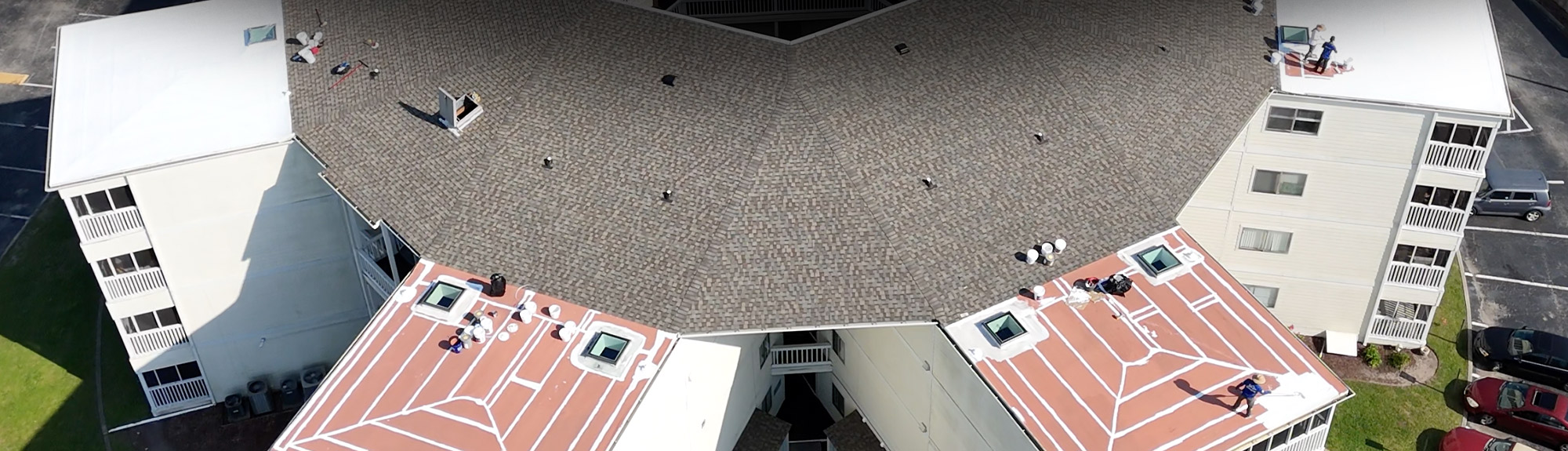
Roofing Installation
When it comes to protecting your commercial property, professional roofing installation is more than a necessity, it’s a strategic investment. At Brazen Roofing, we specialize in commercial roofing installation that is durable, energy-efficient, and tailored to your building’s needs. Whether you’re managing a retail space, office complex, warehouse, or industrial site, our team delivers exceptional results with minimal disruption to your operations.
We work closely with property owners, general contractors, and developers to install high-performance commercial roofing systems that are built to last. Whether you’re breaking ground on new construction or replacing an aging roof, Brazen Roofing brings the technical expertise and grit to get the job done right.
Commercial Roofing Systems We Install
We specialize in a wide range of commercial roofing systems, including:
- TPO (Thermoplastic Polyolefin), reflective, heat-welded seams, the most widely specified single-ply for new low-slope construction
- PVC (Polyvinyl Chloride): chemical and grease resistant, which makes it the right answer over restaurants and manufacturing exhaust
- EPDM (Ethylene Propylene Diene Monomer), long field history, excellent in cold climates, forgiving to repair
- Modified Bitumen, multi-ply redundancy, strong under foot traffic
- Standing Seam Metal Roofing, concealed fasteners and long service life on sloped commercial and multifamily roofs
- PBR Panels (Purlin Bearing Rib): exposed-fastener metal for agricultural, industrial and warehouse structures
Every roofing system we install is strategically selected based on your building type, energy efficiency goals, and long-term performance needs. Whether it’s flat roofs on industrial buildings or sloped metal systems on multifamily complexes, we tailor every solution to fit because we don’t believe in one-size-fits-all. Compare all of them on our commercial roofing systems page.
How We Choose the System for Your Building
Specifying a commercial roof is a series of trade-offs, and the building tells you most of the answer. What we are actually weighing:
- What comes out of the roof. Kitchen grease exhaust rules out some membranes and points straight at PVC. So does chemical exhaust from manufacturing.
- Foot traffic. Roofs with regular HVAC service, equipment access or walkway routes need a membrane and a walkpad plan that tolerate it.
- Drainage and slope. Existing slope, drain locations and any ponding history determine whether tapered insulation or crickets belong in the scope.
- Climate. Reflectivity earns its keep in Myrtle Beach, Savannah, Jacksonville and Oklahoma City. In Denver and Springfield, cold-weather flexibility and hail resistance matter more.
- Wind exposure. Attachment pattern, edge metal and perimeter enhancement are engineered, not chosen by preference. On the coast this is the single most consequential decision in the assembly.
- Insulation and code. Current energy code often requires more R-value than what is coming off, which changes the assembly height and every detail that ties into it.
- How long you are holding the building. A five-year hold and a twenty-year hold justify different roofs, and we will say so.
The Installation Process
- Site assessment and core samples. We confirm what is actually up there rather than what the drawings say. Core samples tell us whether the existing insulation is dry and how many roofs are already in place.
- Scope and specification in writing. Membrane, thickness, insulation, attachment, edge metal, flashing details and warranty tier, itemized. Read how often a commercial roof should be inspected for context on what we look for.
- Logistics planning around your operations. Staging, crane or hoist placement, deliveries, dumpster location and work hours agreed before mobilization.
- Tear-off in controlled sections. Never more open than we can make watertight the same day.
- Deck repair. Anything found under the old roof is documented with photos and priced before it is covered up again.
- Insulation, membrane and detail work. Curbs, drains, penetrations, parapets and terminations, where commercial roofs actually fail.
- Edge metal and perimeter. Wind failures start at the edge, every time.
- Quality control inspection and warranty registration. Brazen’s own inspector signs off, and warranty paperwork is filed rather than left with you to chase.
New Construction and Replacement
We work both sides. On new construction we coordinate with the general contractor and the schedule, which usually means dry-in early and finish detail work around other trades. On commercial roof replacement the constraint is the building staying open, so the sequencing matters more than the roofing.
If the existing roof is sound and the problem is age rather than failure, a roof coating or liquid-applied restoration may buy another service cycle at roughly half the cost of replacement. We will tell you when that is the better answer, and we will tell you when it is not.
We also handle multifamily and HOA roofing, where the specification question is usually shared and the scheduling question is always harder.
Where We Work
Commercial installation across all eleven of our markets: Myrtle Beach and Charleston, South Carolina; Savannah, Georgia; Raleigh, North Carolina; Jacksonville, Florida; Denver and Parker, Colorado; Oklahoma City; and Springfield, Missouri. See Myrtle Beach commercial flat roofing or our full service area.
After the Install
A commercial roof reaches its rated life if it is inspected and maintained, and does not if it is not, and most manufacturer warranties are written that way. Our preventative maintenance program covers scheduled inspection, drain clearing and detail touch-up. For coastal buildings, add a pre-season check using our guide to preparing a commercial roof for hurricane season.
At Brazen Roofing, we’re built on clear communication, efficient timelines, and uncompromising standards. Our commercial crews are fully trained, safety-focused, and equipped to handle projects of any size or complexity with confidence, and every job is signed off by our own quality-control inspector rather than by the crew that installed it.
Looking for a roof that’s as reliable as your business? We’re ready when you are. Schedule your free consultation today, and let’s talk about what your roof really needs. No bull!
Our installations feature our full range of Commercial Roofing Systems. This service is part of our full Commercial Roofing line, and you can see examples in our commercial roof work.
Frequently Asked Questions
It depends on square footage, the assembly and the weather, but the more useful answer is that we tear off only what we can make watertight the same day. That means the building is never open overnight, and the schedule is built around your operations rather than the other way around.
There is no single best system, the building decides. Grease or chemical exhaust points to PVC. Cold climates and repairability favor EPDM. New low-slope construction most often gets TPO. Foot traffic favors modified bitumen or polyurethane-coated assemblies. Sloped commercial and multifamily roofs usually get standing seam metal.
Yes, and that is the normal case. Work is sequenced in controlled sections, staging and deliveries are agreed before mobilization, and work hours are planned around yours. Most of our commercial customers do not close for a day.
Yes. We work directly with property owners, general contractors and developers on both new construction and replacement, including coordinating dry-in early so other trades can proceed.
It gets photographed, documented and priced before anything covers it back up. Deck deterioration and wet insulation are common findings on a tear-off and neither is something we cover over silently.
Yes. Our quality-control inspector signs off on the installation and the warranty registration is filed by us. Unregistered coverage is one of the most common and most avoidable losses in commercial roofing.