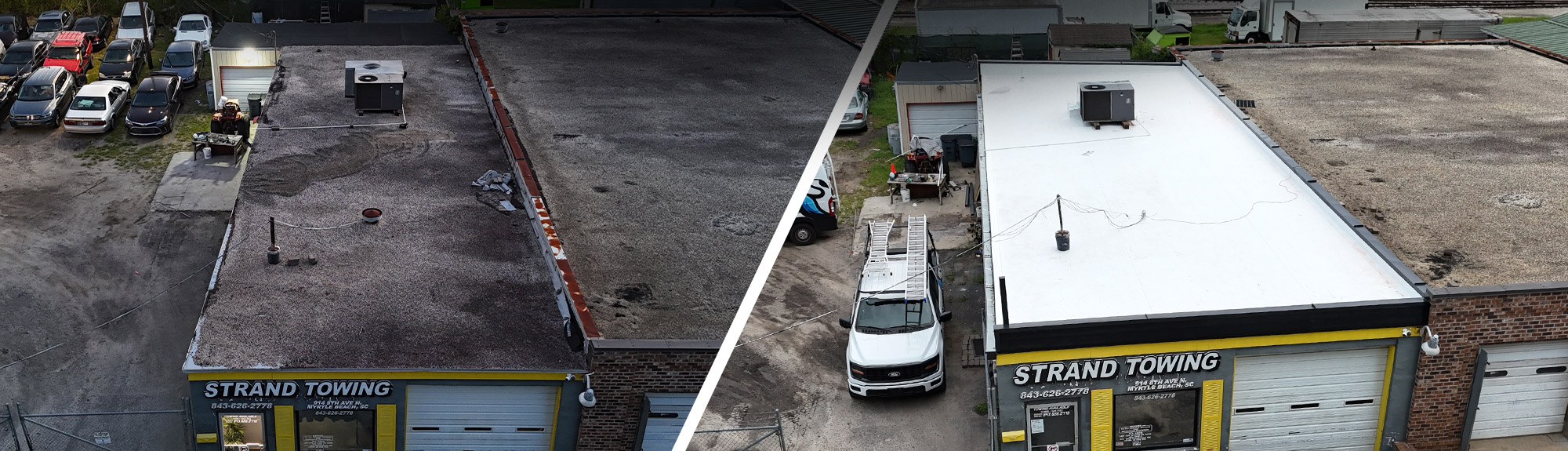
Commercial Roof Replacement
When repairs can’t tackle the job and a full replacement becomes the only move that makes sense, you need a crew that can handle it from tear-off to final inspection. At Brazen Roofing, we make the commercial roof replacement process as smooth and straightforward as possible.
Our experienced team knows how to spot the signs, explain your options, and recommend a solution that fits your building and your budget. Whether it’s worn-out materials, mounting repair costs, or structural concerns—you’ll know exactly where you stand.
We handle every part of the process: full tear-offs, structural evaluations, material upgrades, and full system replacements that meet local codes and manufacturer requirements. Our crews work around active job sites, keep disruptions to a minimum, and move efficiently to keep your timeline on track. When it’s done, you’re left with a roof that’s installed the right way—and ready to do its job.
We’ve handled roof replacements on everything from small commercial buildings to large-scale facilities, and we bring that experience to every project. Our approach is simple: do the work right, keep the site clean, and leave you with a roof you can count on.
Want to know where your roof really stands? Contact us today to schedule your FREE roof inspection!
Not ready for a full replacement? Ask about our Commercial Repairs option. This service is part of our full Commercial Roofing line.
How You Know It Is Time
Most commercial roofs are replaced later than they should be, and a few are replaced years too early. The signals that actually mean replacement rather than repair:
- Wet insulation across a meaningful share of the roof. The decisive one. Once the insulation is saturated it has lost its R-value permanently, it is adding weight, and the deck underneath is corroding whether you can see it or not. No coating and no repair fixes this.
- Two roofs already in place. Most codes cap you at two, and a third is usually not permitted or not structurally sensible.
- Repair spend climbing year over year. When the annual repair bill starts approaching a meaningful fraction of a replacement, you are financing a replacement one leak at a time and getting nothing durable for it.
- Widespread membrane failure rather than isolated defects — splits across multiple areas, shrinkage pulling at terminations, or brittleness across the field.
- Deck deterioration. Soft spots underfoot, or visible corrosion from inside.
- Drainage that was never right. A replacement is the only practical moment to correct slope with tapered insulation and crickets.
The honest version of this list is that most of it is invisible from the roof surface. Which is why we take core samples and run an infrared scan before recommending a replacement — and why we sometimes come back and recommend a coating restoration instead, at roughly half the cost.
What We Assess Before Quoting
- Core samples. How many roofs are up there, what they are made of, and whether the insulation is dry.
- Moisture survey. The true extent of the water, which is nearly always larger than the stained area.
- Deck condition and type. Steel, concrete or wood, and fastener pull-out values.
- Structural capacity. Particularly if the new assembly will be heavier or the old one was ballasted.
- Drainage and slope. Where water goes now and where it should go.
- Code and energy requirements. Current code often requires more R-value than what is coming off, which changes assembly height, curb heights, door thresholds and every tie-in detail.
- Rooftop equipment. What has to be lifted, disconnected or re-curbed, and who coordinates it.
- Wind zone. Which sets attachment pattern, perimeter enhancement and edge metal.
Keeping the Building Open
This is the part that decides whether a commercial replacement goes well, and it is logistics rather than roofing.
- Nothing open overnight. We tear off only what we can make watertight the same day. Weather forecasts drive the daily plan, not the schedule.
- Staging and access agreed before mobilization. Crane or hoist placement, dumpster location, material deliveries, parking impact.
- Work hours matched to yours. Retail before opening, offices around occupancy, restaurants around service, warehouses around shipping windows.
- Interior protection where tear-off is overhead. Dust and debris control matters more than people expect in medical, food service and clean manufacturing.
- Noise and odor planning. Tear-off is loud and some adhesives smell. Tenants should be told in advance rather than discovering it.
- Daily site cleanup. Non-negotiable on an occupied property.
What Happens When We Find Something
We will. Almost every tear-off reveals something the drawings did not show — deteriorated deck, an unexpected second membrane, saturated insulation beyond the surveyed area, or a curb that was never flashed properly.
Every finding gets photographed, documented and priced before anything covers it back up. You approve it before we proceed. That is the whole mechanism, and it is the difference between a change order you understand and one that arrives as a surprise on the final invoice.
Choosing the New System
A replacement is the one chance to correct what was wrong with the old roof, so the system choice should follow the building rather than whatever was there before:
- TPO — reflective and welded, the most common choice for a straightforward low-slope replacement
- PVC — required wherever grease or chemical exhaust reaches the roof, which covers any building with a restaurant tenant
- EPDM — cold climates, hail exposure and buildings where easy future repair is worth paying for
- Modified bitumen — multi-ply redundancy under regular foot traffic
- Metal — standing seam and PBR for sloped and semi-sloped sections
- Commercial shingle — multifamily, HOA and sloped commercial
Compare all of them on our commercial roofing systems page, and see our installation process for how each is detailed.
Warranty, Documentation and What Comes After
At closeout you should receive a registered manufacturer warranty, our workmanship coverage, and the maintenance requirements the coverage depends on. Unregistered warranties are the most common avoidable loss in commercial roofing, and the owner usually discovers it during the first leak.
Then keep it inspected. A new roof with no maintenance record is a warranty claim waiting to be denied. Our preventative maintenance program handles scheduled inspection, drain clearing and documentation — see how often a commercial roof should be inspected and why roof maintenance is essential for your business.
Not ready for a full replacement? Ask about our Commercial Repairs option. This service is part of our full Commercial Roofing line, and you can see examples in our commercial roof work.
Frequently Asked Questions
Whether the insulation underneath is wet. Isolated defects on a roof with dry insulation are repairs, and often a coating restoration at half the cost of replacement. Saturated insulation, widespread membrane failure, or two roofs already in place mean replacement. Core samples and an infrared scan answer it; a walkthrough cannot.
Yes, and that is the normal case. We tear off only what can be made watertight the same day, agree staging and work hours before mobilizing, and protect the interior where tear-off happens overhead. Most of our commercial customers do not close for a day.
It gets photographed, documented and priced, and you approve it before we cover it back up. Deteriorated decking, an unexpected second membrane and moisture beyond the surveyed area are all common findings, and none of them get quietly covered over.
Usually, and it catches owners out. Current code often requires more insulation R-value than what is coming off, which raises the assembly height and changes curb heights, door thresholds, parapet details and every tie-in. It belongs in the scope from the start, not as a change order.
Not necessarily. A replacement is the one opportunity to correct what was wrong — drainage, insulation depth, the wrong membrane for the building’s exhaust. If the old roof failed early, repeating it is rarely the right call.
It depends on square footage, the assembly and the weather, but the more useful measure is that the building is never open overnight. The daily plan is driven by what can be made watertight before the crew leaves, and the forecast is part of that plan.