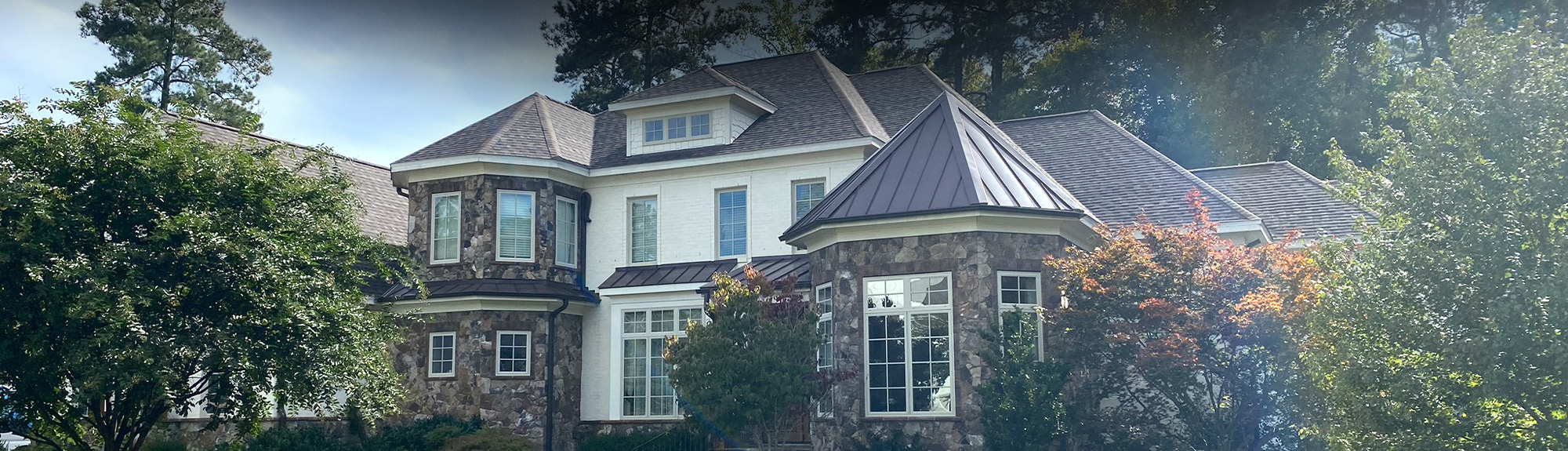
Residential Shingle Replacement
Raleigh sees a wide range of weather across the year: hot, humid summers, occasional ice, and severe thunderstorms. That variety wears on shingle roofs faster than most homeowners expect. A shingle roof replacement means removing worn or damaged shingles down to the decking and installing a system built to handle everything the Triangle throws at it.
We start with a full inspection of your decking and flashing. Replacing shingles over a bad deck just delays the real problem. From there, we walk you through shingle options and pricing, so you know exactly what you’re getting before we start.
We’ve replaced roofs across Raleigh long enough to know which materials and installation details actually hold up here. That’s especially true through Piedmont-region storms and temperature swings.
- Free inspection and shingle replacement estimate
- Decking and flashing checked before any new shingles go on
- Materials chosen for Raleigh’s weather swings and storm exposure
Ready to replace your shingle roof? Contact Brazen Roofing for a free Raleigh estimate. This is part of our full Residential Roofing service line. Raleigh property managers should also see our Commercial Roofing services. Homeowners can browse our Raleigh project gallery for examples of completed work.
What Piedmont Weather Does to Shingles
Raleigh is not an extreme climate, which is exactly why homeowners here are surprised when a roof wears out early. The damage is cumulative and thermal rather than dramatic.
- Freeze-thaw cycling. The Triangle crosses freezing and back repeatedly through the winter rather than staying cold. Each cycle expands and contracts the shingle, works nails loose, and opens tiny cracks. Over fifteen years that daily movement does more damage than any single storm.
- Ice and winter storms. Occasional, and consequential when they arrive. Ice damming at eaves pushes water backward under the shingle courses, which is why ice-and-water membrane placement at eaves is a real design decision here rather than a default.
- Hot, humid summers. Heat drives the oils out of asphalt so the shingle stiffens, and a stiff shingle cracks under the next thermal cycle instead of flexing with it.
- Severe thunderstorms and hail. The Triangle gets both. Not Oklahoma frequency, but enough that a hail check after a significant storm is worth doing.
- Hurricane remnants. Raleigh is inland, not exempt. Tropical systems tracking up from the coast still bring sustained wind and days of rain, and they find loose edge metal and broken seal strips.
- Pine. Pine needles are the single most effective gutter clog there is, and pine shade slows drying on north-facing planes, which encourages the algae streaking you see across the Triangle.
The Decking Inspection Comes First
We start with a full inspection of your decking and flashing, because replacing shingles over a bad deck just delays the real problem: and compromised sheathing will not hold a nail properly, which quietly undoes the wind rating you are paying for.
What turns up on Triangle houses: soft or delaminated sheathing under a long-running flashing leak, plywood degraded around bathroom exhaust that was vented into the attic rather than out through the roof, and OSB that has swelled at the joints after sustained moisture. On the many Raleigh homes built during the 1990s and 2000s, the deck is usually sound, the ventilation frequently is not.
Anything we find is photographed and priced before it is covered back up.
Ventilation Is the Raleigh Problem
If we had to name the single reason Triangle roofs underperform, it is attic intake. A great many homes here have ridge vent for exhaust and nowhere near enough soffit intake to feed it. The result is an attic that never moves air: shingles baked from below in summer, moisture condensing on the sheathing in winter, and a roof that loses years off its rated life without a storm ever touching it.
It also produces the two symptoms homeowners describe without connecting them: upstairs rooms that will not cool, and mysterious damp or frost in the attic in January. Both are the same problem. A roof replacement is the one moment fixing it is cheap, because the access is already open. See why proper roof ventilation matters.
What We Specify Here
- Architectural shingles installed to the enhanced nailing pattern: a condition of the rated wind speed, not an upgrade. See architectural and designer shingles.
- Algae-resistant shingles, because pine shade and humidity make streaking a matter of when.
- Synthetic underlayment, with ice-and-water membrane at eaves and in valleys. This is the detail that earns its cost in a Piedmont ice storm.
- Sealed starter strip at eaves and rakes, and matched ridge cap, usually required for full warranty coverage.
- New flashing at every wall, chimney, skylight and valley, replaced rather than reused, plus kickout flashing where a roof plane meets a wall and new pipe boots.
- Bath and kitchen exhaust terminated through the roof, not into the attic. We find this constantly and it is the cause of a lot of sheathing damage.
- Corrected intake ventilation, done during the replacement.
Class 4 impact-rated shingles are worth pricing if you have taken hail before. Metal and GAF TimberSteel both perform well through freeze-thaw and last two to three times as long, so worth a look if you intend to stay.
What the Week Looks Like
- Inspection and written scope: shingle options and pricing, so you know exactly what you are getting before we start.
- Delivery and protection of landscaping, driveway and anything below the eaves.
- Tear-off in sections, never more open than can be made watertight the same day. Summer afternoon storms drive the daily plan.
- Deck repair as found, photographed and priced.
- Dry-in, flashing, ventilation corrections, then field shingles.
- Nail sweep and cleanup every evening.
- Quality-control inspection by Brazen staff rather than the installing crew, then warranty registration filed by us.
Spring and autumn are the easiest windows here. Winter work is possible, shingle sealing simply takes longer to activate in cold weather, which is a timing consideration rather than a defect.
After the Roof Is On
Keep the contract, invoice, registered manufacturer warranty and the photo record together. It matters at resale, and it is what an insurer asks for after a storm. Unregistered coverage is the most common avoidable loss in residential roofing, and we file it rather than leaving it to you.
Then have it looked at annually, and after any significant storm, hail damage in particular is very hard to see from the ground. Our roof maintenance program covers scheduled inspection with a dated photo report, which gives you a documented before-condition. For storm work start at storm restoration.
More about Brazen in the Triangle on our Raleigh roofing page. This is part of our full Residential Roofing line, see roof replacement for the general process, book a free roof inspection, or see financing. For commercial buildings see Raleigh commercial flat roofing.
Frequently Asked Questions
Around 20 years for architectural shingles, though attic ventilation moves that figure more than anything else. Repeated freeze-thaw cycling through a Piedmont winter is the main aging mechanism, and an under-ventilated attic accelerates it from the other direction.
Almost certainly the same problem: not enough soffit intake ventilation to feed the exhaust. Many Triangle homes have ridge vent and insufficient intake, so the attic never moves air, shingles bake from below in summer and moisture condenses on the sheathing in winter. A roof replacement is the cheap moment to fix it.
At eaves and in valleys, yes, and it is worth insisting on. The Triangle gets occasional ice storms, and ice damming at the eaves pushes water backward under the shingle courses where ordinary underlayment will not stop it.
It gets photographed, priced and shown to you before anything covers it up. Beyond the repair cost it matters because compromised sheathing will not hold a nail properly, which undoes the wind rating you paid for.
They are algae, not damage, and they are common across the Triangle because pine shade keeps north-facing planes damp. Largely cosmetic, but algae-resistant shingles are worth specifying on a replacement here.
Yes. Shingle sealant activates more slowly in cold weather, so the roof takes longer to fully seal down: a timing consideration rather than a defect. Spring and autumn are the easiest windows, but a failing roof should not wait for a season.