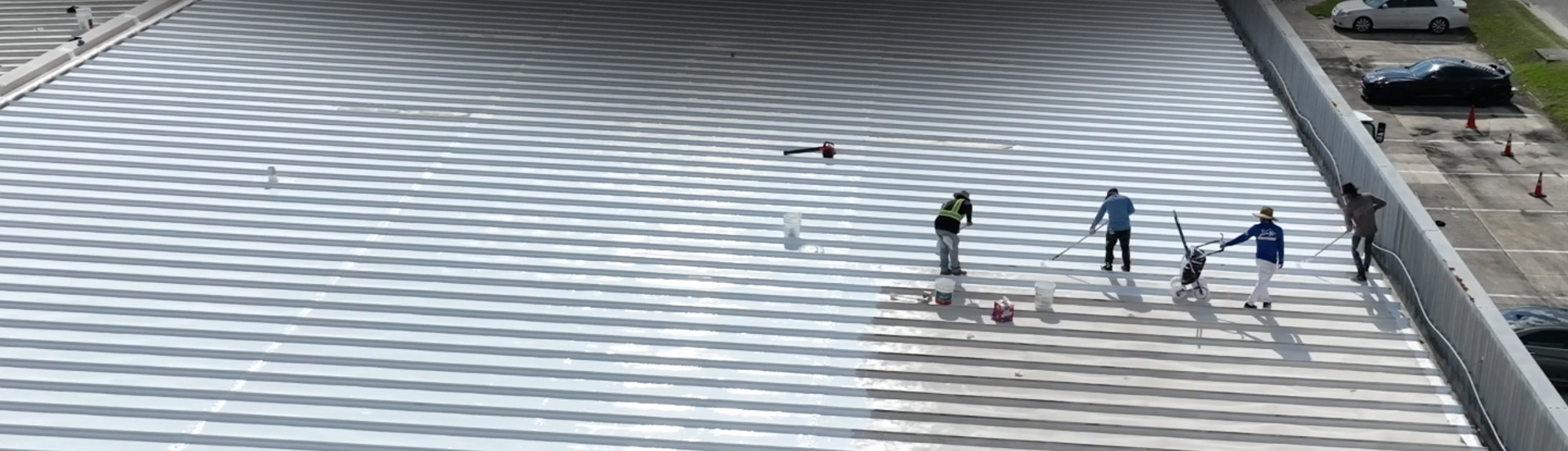
Roof Coatings
In addition to commercial roof installations and replacements, Brazen Roofing also offers roof coating systems for commercial roof applications.
Commercial roof coatings are proven to stop leaks, reduce energy cost, prevent rust and corrosion, and extend service life. Best of all, commercial roof coating systems cost half as much as conventional roof replacements and are backed by long-term labor and material warranties to provide you with added protection and peace of mind.
The Benefits of Commercial Roof Coatings
- Stops leaks and vastly improves performance
- Prevents the formation of rust and corrosion
- Costs significantly less than replacement
- Substantially reduces maintenance and energy costs
- Extends service life by restoring the existing roof membrane
- Provides excellent UV stability, reflectivity, and durability
- Creates a seamless and watertight roofing membrane
- Provides minimal disruption to your business
- Long-term warranty options available
Suitable Commercial Roofing Substrates
- Modified bitumen
- Metal
- Built-up roofs (BUR)
- Single-ply (EPDM, PVC, TPO)
- Spray Polyurethane foam (SPF)
- Concrete
When a Coating Is the Right Call — and When It Is Not
A coating is a restoration, not a replacement. It buys a sound roof another service cycle at roughly half the cost and with almost no disruption to the building below. On the wrong roof it buys nothing but a delay, and we will tell you which one you have before we quote it.
A coating usually makes sense when:
- The membrane is intact and the leaks are at seams, laps, fasteners or penetrations rather than through the field.
- Core samples come back dry, meaning the insulation underneath has not been saturated.
- The roof has one existing membrane, not a stack of them.
- Ponding is limited and drains are functional.
- The building cannot tolerate a tear-off — occupied offices, medical space, food service, manufacturing with sensitive equipment.
- You need to move capital expense into a shorter horizon while a replacement is budgeted.
A coating is the wrong answer when:
- The insulation is wet. Coating over saturated insulation seals the water in, and the deck underneath keeps deteriorating out of sight.
- The membrane has widespread splits, blisters or shrinkage rather than isolated defects.
- There is standing water that no amount of coating will resolve, which is a drainage and slope problem.
- The deck itself is compromised.
- More than one roof is already in place and the assembly is at its load limit.
The way we tell the difference is core sampling and a moisture survey, not a visual walk. That inspection is where the decision gets made honestly. Read what to expect during a commercial roof inspection before you schedule one.
Coating Types, and What Each One Is Good At
“Roof coating” covers several different chemistries that behave very differently in service. The right one depends on your substrate, your drainage and your climate.
- Silicone. The most weather-tolerant option and the best performer where ponding water is a fact of life. Holds up to UV without chalking. It attracts dirt over time, which cuts reflectivity, and recoating requires the right primer.
- Acrylic. Highly reflective, cost-effective and easy to recoat, which makes it strong on energy savings in hot climates. It is water-based, so it needs a dry cure window and does not tolerate standing water.
- Polyurethane. The toughest of the three under foot traffic and hail, which makes it the choice for roofs with regular rooftop service, equipment access or walkway routes.
- Asphaltic and modified bitumen coatings. Compatible with existing BUR and mod-bit roofs, generally used where matching the existing assembly matters more than reflectivity.
- Spray polyurethane foam with a coating over it. Adds insulation value and re-slopes minor ponding areas at the same time, then gets a silicone or acrylic topcoat for UV protection. This is the liquid-applied roofing approach in full.
How the Work Actually Goes
Coating work is done around your operating hours, from the roof, without a dumpster in the parking lot and without a tear-off overhead. The sequence is consistent:
- Survey and core samples. Confirm the membrane and insulation are dry and the substrate is a candidate.
- Repairs first. Splits, open laps, failed fasteners and bad flashings get repaired before anything is coated. A coating is not a repair.
- Cleaning. Power wash and, where needed, a chemical clean. Adhesion failures almost always trace back to a surface that was not clean.
- Primer. Substrate-specific, and not optional on metal or aged single-ply.
- Detail work. Reinforcing fabric at seams, curbs, drains, pipe penetrations and parapet transitions. This is the part that determines whether the system holds.
- Base and top coat. Applied at the manufacturer’s specified mil thickness and verified wet, not estimated.
- Inspection and warranty registration. Our own quality-control inspector signs off before the manufacturer warranty is submitted.
Warranty and Energy Savings
Coating warranties are usually offered in tiers — ten, fifteen or twenty years — and the tier is set by the coating thickness applied and by whether the manufacturer inspects the installation. A thin application to hit a price point costs you the warranty length, which is the whole reason to do the work. We quote to a specified mil thickness and put it in writing.
Ask for the distinction between a material-only warranty and one that covers labor to make repairs. They are not the same product, and the difference shows up the first time you have a leak. Registration matters too — unregistered coverage is a common and avoidable loss.
The reflectivity story is real but climate-dependent. A white reflective coating on a dark membrane in Myrtle Beach, Savannah, Jacksonville or Oklahoma City cuts rooftop surface temperature substantially and reduces cooling load through the summer. In Denver and Springfield the summer savings are smaller and the durability case matters more than the energy case.
Keeping the Coating Working
A coated roof is a maintained roof or it is a wasted investment. Annual inspection, drain clearing and touch-up at penetrations is what gets you to the end of the warranty term, and it is also the condition most manufacturers attach to their coverage. Our preventative maintenance program handles it on a schedule, and we cover the reasoning in why roof maintenance is essential for your business.
If you are on the coast, add a pre-season check. Our guide to preparing a commercial roof for hurricane season covers what to look at.
If you’re in need of a commercial roof coating solution that will save you time and money, contact us to learn more about the products and services we can provide your commercial business!
Roof coatings are one of several options in our Commercial Roofing Systems lineup, part of our full Commercial Roofing line. If a coating turns out not to be the answer, see commercial roof replacement or commercial repairs.
Frequently Asked Questions
Ten to twenty years, depending on the coating chemistry, the mil thickness applied and how well the roof is maintained. The warranty tier a manufacturer will issue is tied directly to thickness, so a thinner application to reach a lower price also shortens the coverage you get.
Yes, typically around half the cost of a conventional replacement, and it avoids tear-off, disposal and the disruption of open roof work over an occupied building. That comparison only holds if the existing membrane and insulation are dry, which is what core sampling determines.
No. Modified bitumen, metal, built-up, single-ply and spray foam roofs are all candidates, but only if the insulation underneath is dry and the membrane defects are isolated rather than widespread. Coating over wet insulation seals the moisture in and lets the deck keep deteriorating.
Silicone handles ponding water and UV better, which makes it the safer choice on roofs with slow drainage. Acrylic is more reflective and easier to recoat later, which makes it stronger on energy savings in hot climates. Polyurethane is the most durable underfoot where there is regular rooftop traffic.
A coating is not a repair. Splits, open laps, failed fasteners and bad flashing details are repaired first, then the coating goes over a sound surface and creates a seamless membrane that eliminates the seams where most leaks start. Anyone who proposes coating over active defects without repairing them is selling you a delay.
Yes, and most manufacturer warranties require it. Annual inspection, clearing drains, and touching up penetrations and transitions is what carries the system to the end of its term.