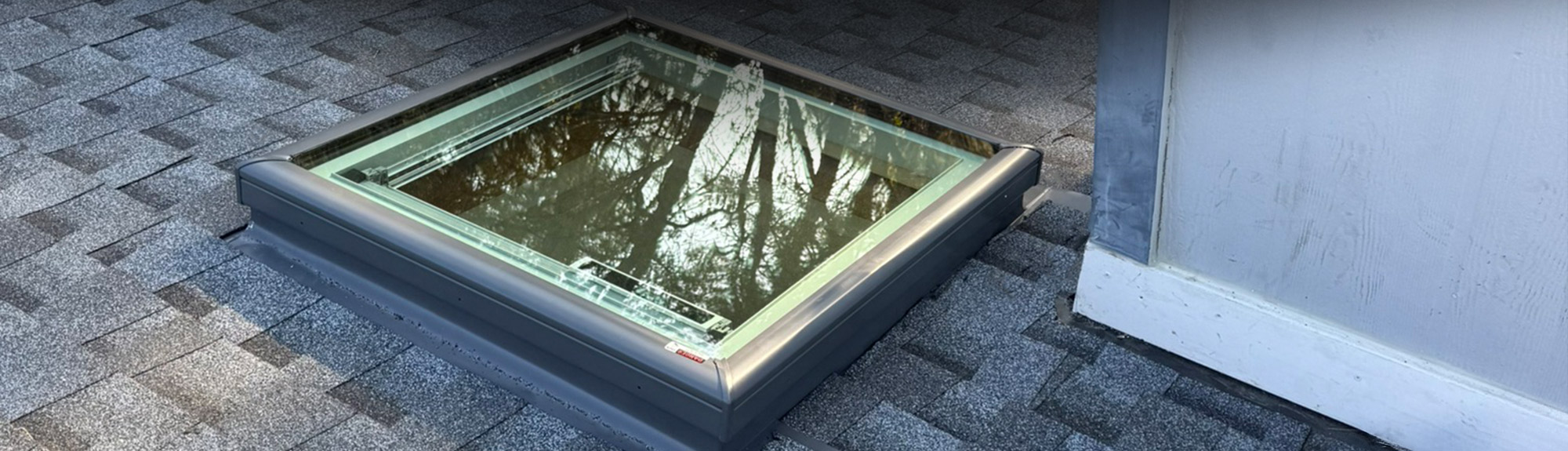
Skylight Repair
A leaking or fogged-up skylight can turn a favorite feature of your home into a headache fast. Skylight repair covers everything from resealing and flashing repairs to full skylight replacement, so natural light stops being a liability and goes back to being a perk.
Skylights fail in a few predictable spots: the flashing where the frame meets the roof, the seal around the glass, and the glazing itself. Our team inspects each of these points, identifies exactly where water is getting in, and repairs or replaces only what’s needed.
Because skylights sit at a seam in your roofline, a bad repair, or a skylight installed without proper flashing, can cause damage well beyond the fixture itself. We install and repair skylights the right way the first time, so you don’t end up fixing the same leak twice.
- Diagnose and repair leaks at the flashing, seal, or glazing
- Full skylight replacement when a repair won’t cut it
- Proper flashing integration so the fix protects the rest of your roof, too
We repair and replace skylights for homeowners across our full residential roofing service area, including Myrtle Beach, Charleston, Savannah, Raleigh and Jacksonville on the coast, and Denver, Oklahoma City, Springfield, Wichita, Columbus, Milwaukee and Knoxville inland. If your skylight leak turns out to be part of a bigger roofing issue, our team can also handle a full roof inspection or broader roofing repair while we’re there, and we’ll always tell you honestly if full roof replacement makes more sense than a repair.
Got a leaky or fogged skylight? Contact Brazen Roofing for a free inspection.
Where Skylights Actually Leak
Almost never through the glass. A skylight leak is a flashing leak, and knowing that changes what a competent repair looks like.
- The flashing kit. Step flashing up the sides, a head flashing at the top and an apron at the bottom, woven into the shingle courses. If this was improvised rather than installed as a matched kit, the skylight was leaking from day one and simply had not shown yet.
- Sealant used instead of flashing. The single most common bad repair we are called to correct. A bead of caulk around a skylight is a two-year fix on a thirty-year problem, and every reapplication makes the eventual proper repair harder.
- The seal between glass and frame, which ages out. On older units this is what fails, and it is usually the point at which replacement beats repair.
- The curb on curb-mounted units: rot at the wooden curb, or flashing terminated too low on it.
- Dead valleys above the skylight, where a roof plane dumps water straight onto the head flashing. A cricket or diverter belongs there and frequently is not.
- Condensation, which is not a leak at all. Water dripping from a skylight in winter is often warm indoor air condensing on cold glass. That is an attic ventilation and humidity problem, and no amount of flashing work fixes it.
Curb-Mounted vs. Deck-Mounted
The two are installed differently and they fail differently, so it is worth knowing which you have.
- Deck-mounted units sit low against the roof with an integrated flashing kit. Cleaner profile, better weather performance when installed correctly, and less forgiving of a sloppy install.
- Curb-mounted units sit on a built-up wooden curb. Easier to retrofit, and the curb itself becomes a maintenance item, rot at the curb is a common cause of failure on older installations.
Repair or Replace?
We will tell you which one you have rather than defaulting to the bigger job.
- Repair when the unit is sound and the problem is the flashing, the curb or a dead valley above it. That is most of what we see.
- Replace when the glass seal has failed, the frame is deteriorated, or the unit is old enough that reflashing a failing skylight is money spent twice.
- Replace during a roof replacement, always. This is the one we push on. A skylight is a hole in your roof, and reusing an old unit and its flashing under a brand-new roof is one of the most common false economies in this trade. The labor is already there and the flashing has to be redone regardless, the only additional cost is the unit itself. See roof replacement.
Ventilation, Condensation and Winter Drips
If water appears at your skylight in cold weather and the roof is otherwise fine, suspect condensation before you suspect a leak. Warm humid indoor air meets cold glass and the moisture drops out of it, exactly as it does on a bathroom mirror.
The fix is attic ventilation, air sealing and humidity control rather than roofing. See why proper roof ventilation matters. In our northern markets this is common enough in winter that we check it before quoting flashing work.
Skylights on Other Roof Types
Flashing details differ substantially by material, and this is where inexperienced installers get into trouble, on metal, the detail has to allow the panel to keep moving with temperature; on tile and slate, the surrounding pieces have to be lifted and relaid rather than broken; and on low-slope sections a skylight needs a proper curb height above the membrane.
Skylight work is part of our full Residential Roofing line. If you have a leak you cannot place, start with a roof inspection or a free roof inspection, skylights and their flashing are one of the most commonly misdiagnosed leak sources on a house. See also roofing repair.
Frequently Asked Questions
Related reading on skylights
- Skylight leaks: curb-mounted versus deck-mounted: which one you have decides how it fails
Almost certainly the flashing rather than the glass. Step flashing up the sides, head flashing at the top and an apron at the bottom have to be woven into the shingle courses as a matched kit. If sealant was used instead, the repair was temporary from the start.
It can be, and it is the most common bad repair we are called to correct. A bead of caulk is a two-year fix on a thirty-year problem, and every reapplication makes the eventual proper repair harder. The flashing needs rebuilding.
Yes, in almost every case. A skylight is a hole in your roof, the flashing has to be redone regardless, and the labor is already on site, so the only additional cost is the unit itself. Reusing an old skylight under a brand-new roof is one of the most common false economies in roofing.
That is usually condensation rather than a leak. Warm humid indoor air meets cold glass and the moisture drops out of it. The fix is attic ventilation, air sealing and humidity control, no amount of flashing work will change it.
Deck-mounted units sit low against the roof with an integrated flashing kit: a cleaner profile and better weather performance when installed correctly. Curb-mounted units sit on a built-up wooden curb, which is easier to retrofit but becomes a maintenance item, since rot at the curb is a common failure on older installations.
Yes, and the flashing detail differs substantially by material. On metal the detail must allow the panel to move with temperature; on tile and slate the surrounding pieces have to be lifted and relaid rather than broken; on low-slope sections the skylight needs proper curb height above the membrane.