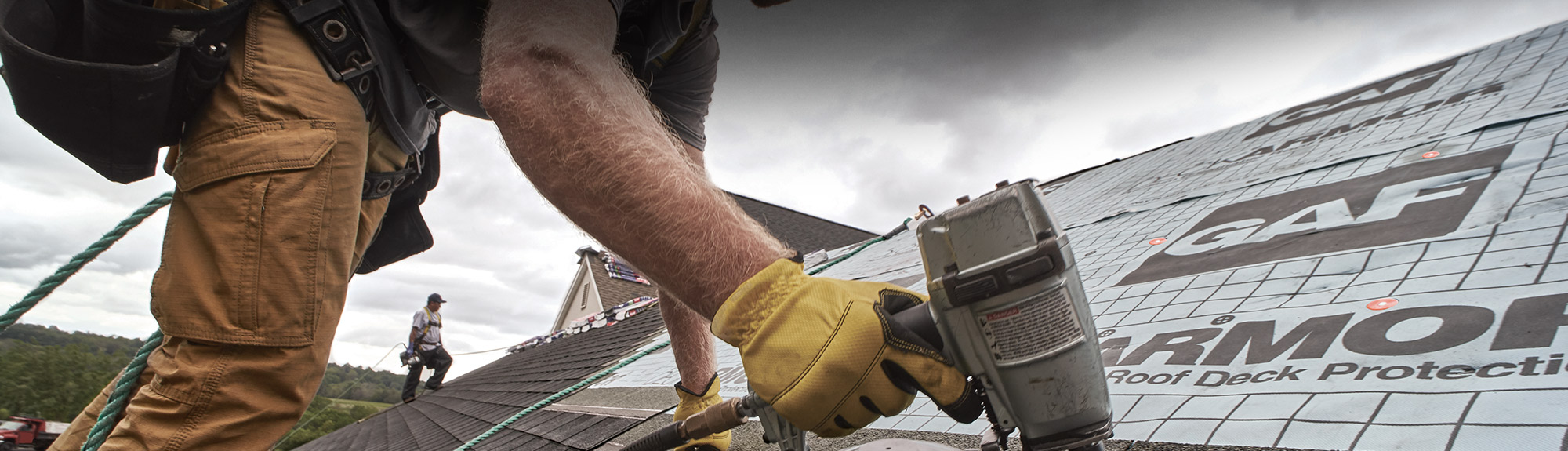
GAF Roofing System
As a GAF Master Elite certified contractor we install a complete GAF Roofing System. Our residential roofing experts will get the job done right, giving you peace of mind that your new roof is sturdy and reliable.
The GAF Roofing System is available with our Roof Replacement service, part of our full Residential Roofing line.
A Roof Is a System, Not a Pile of Shingles
Most homeowners buy a roof by choosing a shingle. But the shingle is only the visible layer of an assembly, and the assembly is where roofs succeed or fail. Water almost never comes through the middle of a shingle — it comes in where two components meet.
A complete manufacturer system means every layer comes from the same manufacturer, engineered and tested to work together:
- Leak barrier at eaves, valleys and around penetrations — the self-adhering membrane that seals around a nail rather than just sitting under it.
- Underlayment across the whole deck. Synthetic rather than felt: it does not tear, does not wrinkle when it gets wet, and holds up if weather arrives before the shingles do.
- Starter strip at eaves and rakes, with a factory-applied sealant line. This is what wind pulls on first, and cut-up three-tab used as starter is a genuinely different product.
- Field shingles — the layer you actually chose.
- Ridge cap designed for the ridge, not field shingles cut into thirds.
- Ventilation — ridge exhaust matched by adequate soffit intake, sized rather than guessed.
- Flashing and accessories at walls, chimneys, skylights and vents.
Buy those seven from seven different suppliers and it usually works. When it does not, nobody is responsible for the assembly — each manufacturer points at the next one. That, rather than the branding, is the argument for a single system.
Why the Accessories Matter More Than the Shingle
If you compare two estimates and one is meaningfully cheaper, the difference is rarely the field shingle. It is almost always underneath it.
- Felt instead of synthetic underlayment. Cheaper per roll and it tears during installation and wrinkles when wet.
- No leak barrier in valleys, which is where the water volume is highest on the entire roof.
- Three-tab shingles cut up and used as starter, with no factory sealant line at the eave.
- Field shingles cut into ridge cap, which bends against the grain and cracks.
- Reused flashing at walls and chimneys.
- Exhaust vents installed with no check on intake, which is a warranty condition as well as a performance problem.
Every one of those is invisible from the street the day the job finishes, and every one of them shortens the roof. When you compare quotes, compare the accessory lines — underlayment type, leak barrier locations, starter product, ridge cap product, flashing new or reused. That is where the money went.
The Warranty Is the Point
A complete manufacturer system is what unlocks the stronger warranty tiers, and this is the practical reason to care.
- Basic material coverage comes with the shingles and generally prorates down over time.
- System coverage requires the manufacturer’s accessories throughout the assembly — not just their shingles — and covers more, for longer, with less proration.
- The top tiers are available only through contractors the manufacturer has certified, and typically add non-prorated periods and workmanship coverage backed by the manufacturer rather than only by the contractor.
- All of them are conditional. Correct nail placement, matched accessories, adequate ventilation, and registration. Any of those missing is a route to a denied claim.
That last point is the one that costs people money. An unregistered warranty is not a warranty — it is the most common avoidable loss in residential roofing, and homeowners usually discover it years later during a leak. We register it, and our own quality-control inspector signs off on the installation before the submission goes in, separately from the crew that did the work. Our overview of GAF roofing warranties covers how the tiers differ.
Contractor Workmanship vs. Manufacturer Coverage
Two different warranties, and homeowners routinely assume the first one covers everything.
Manufacturer coverage handles the product. Workmanship coverage handles the installation, and in the first decade the workmanship half is the one that actually gets used — because early failures are almost always installation, not material. Ask any roofer for both in writing, and ask how long the workmanship coverage runs. A one-year workmanship warranty on a thirty-year roof tells you something.
What This Means on Your Roof
Practically: a complete system, installed by a certified crew, checked by our own inspector, with the warranty registered and the paperwork handed to you rather than filed nowhere. Compare material options on our architectural and designer shingles page, or the full range of roofing types. For metal, we install GAF TimberSteel — see installation and the TimberSteel guarantee.
Many roof replacements and installations use this system. Start with a free roof inspection or a roof inspection, and see financing. This service is part of our full Residential Roofing line. For commercial buildings, see the GAF Commercial System. Afterwards, our roof maintenance program keeps the warranty conditions satisfied.
Frequently Asked Questions
Every layer of the roof from one manufacturer, engineered to work together: leak barrier, underlayment, starter strip, field shingles, ridge cap, ventilation, and flashing accessories. Roofs leak where components meet, so a tested assembly matters more than any single product in it.
It usually works, and when it does not, no one is responsible for the assembly — each manufacturer points at the other. It also forfeits the stronger warranty tiers, which require the manufacturer’s accessories throughout rather than just their shingles.
Almost never on the field shingle. Usually felt instead of synthetic underlayment, no leak barrier in the valleys, three-tab cut up as starter strip, field shingles cut into ridge cap, and reused flashing. All of it is invisible from the street the day the job ends.
Yes, and it is the most commonly missed step in residential roofing. An unregistered warranty is effectively no warranty, and homeowners tend to find that out years later during a leak. We file the registration and hand you the documentation.
The manufacturer covers the product; the contractor covers the installation. In the first decade the workmanship half is the one that gets used, because early failures are almost always installation rather than material. Ask for both in writing, and ask how long the workmanship coverage runs.
Most often incorrect nail placement — nails driven above the shingle’s nailing zone. Inadequate attic ventilation, mismatched or missing starter strip and ridge cap, installing over a deteriorated deck, and failing to register the coverage will all do it too. Every one of those is an installation issue.