Commercial Roofing
Brazen Roofing serves commercial and industrial customers across the Carolinas, Georgia, Florida, Colorado, Oklahoma, Missouri, Wisconsin, Ohio, Kansas and Tennessee. We offer expert services and affordable prices on all commercial roof repairs and installations.
When it comes to roofing, there is a big difference between residential and commercial roofing. Commercial roofing companies have to deal with a lot more variation, since the roofs of different office buildings and warehouses can be dramatically different from one another. Additionally, commercial roofs are more likely to have problem areas due to their low slope or flat design, which can allow water and other precipitation to easily collect.
As a result, Brazen Roofing is prepared to deal with a wide range of issues, from repairing leaks to replacing entire sections of roofing. We are also aware of the different types of commercial roofing materials that are available, as well as the benefits and drawbacks of each. By understanding the challenges that come along with commercial roofing, we are fully prepared to meet the needs of our commercial clients as well as implement roofing solutions that will save you money.
Contact us today to schedule a free commercial roofing estimate!
Our commercial services include Roofing Installation, Commercial Roofing Systems, Roof Coatings, and the GAF Commercial System. Looking for a commercial roofer near you? Find your local team on our service area map.
Contact Brazen Roofing
Commercial roofing systems we install
The right system depends on the building, the deck, what is already up there and how the roof is used. Each of these has a page of its own:
- TPO. Heat-welded single ply, reflective, widely specified on new commercial work. Seams are the thing to inspect.
- PVC. Similar installation to TPO with considerably better resistance to grease and oils, which is why it is the sensible choice on restaurant and food-processing buildings.
- EPDM. Durable rubber membrane with a long track record. Shrinks slowly over decades and pulls at terminations, so the details deserve attention at every inspection.
- Modified bitumen. Multi-ply asphalt systems. Lap seams and granule loss are the tells, and hail is the main risk.
- Metal systems. Panels move with temperature, so fastener backout and sealant at penetrations are the recurring maintenance items rather than the panels themselves.
- Liquid applied and coatings. Can add a decade to a sound roof without a tear-off, provided the insulation beneath is dry.
- Commercial shingle. For steep-slope commercial and multi-family buildings.
Find out what you actually have before you price a replacement
The biggest variable in a commercial roofing bid is what has to come off. Most buildings have no reliable construction records, so contractors either guess high to protect themselves or guess low and issue change orders later. Two things remove the guesswork:
- Infrared scanning surveys the whole roof and shows where moisture is, by detecting areas that release heat differently after sunset because wet material holds heat.
- Core sampling confirms exactly what the assembly is at a given point: how many layers, what each one is, the insulation type and whether it is wet, and the condition of the deck.
Scan first, then core the areas the scan flags plus one or two it shows as dry. That combination is what tells you whether a recover or coating is viable at all, or whether the insulation has to come out.
Replacing a roof while the building stays open
Most commercial replacements happen without closing. The roof is divided into sections, each section is torn off and made watertight the same working day, and the sequence works around the parts of the building where disruption matters most.
In practice the complaints come down to noise, odor and dust rather than access. Mechanically fastening through a steel deck transmits sound into the space below; adhered systems are markedly quieter. Solvent adhesives and hot work produce odor, and where your outside air intakes sit matters more than the product choice. Installing a new roof without shutting down covers this in full, including the questions worth asking before you sign.
Inspection, maintenance and your warranty
This is the part building owners most often discover too late. Manufacturer warranties on commercial systems commonly carry maintenance and inspection conditions: and where a claim is made years into the term with no inspection history to produce, the manufacturer can decline it. We have seen otherwise valid claims fail on documentation alone.
Most commercial roofs should be inspected twice yearly, more often past the halfway point of their expected life, and after any significant storm. How often a commercial roof should be inspected covers the schedule by system type, and a preventative maintenance agreement is the simplest way to satisfy a warranty condition and keep the paper trail in one place.
Worth reading alongside it: wind uplift and edge metal, since most wind failures start at the perimeter rather than the field, and restaurant grease and membrane damage if your building has a commercial kitchen.
Buildings we work on
- Retail, restaurants and hospitality
- Offices and light industrial
- Warehouse and distribution
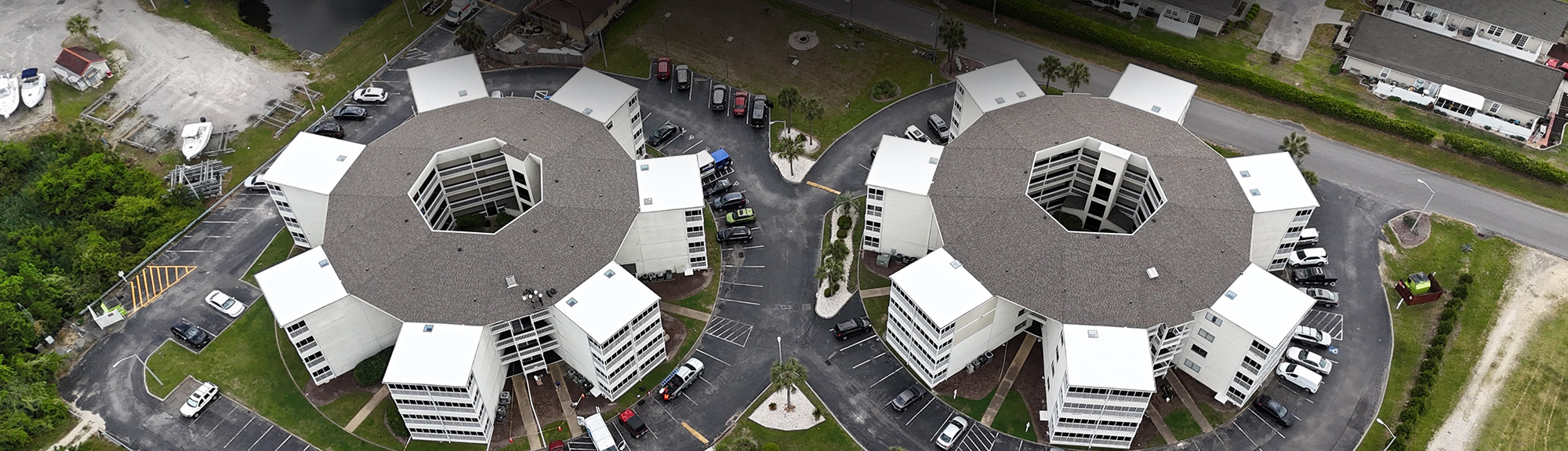
- Multi-family, condominium and HOA properties
- Medical, dental and care facilities
- Schools, churches and municipal buildings
- New commercial construction
We work across all eleven of our markets, see our service area. Existing work is on our commercial roof work, and commercial repairs covers targeted work where a full replacement is not warranted.
Commercial roofing questions
Related reading for building owners
- How to choose the right commercial roofing contractor: what to verify before you sign
- Roof access and fall protection for building owners: your liability, not just the contractor’s
Commercial roofing by market
- Commercial flat roofing in Myrtle Beach, SC
- Commercial flat roofing in Savannah, GA
- Commercial flat roofing in Raleigh, NC
- Commercial roof waterproofing in Jacksonville, FL
- Commercial flat roof repair in Denver, CO
- Commercial roofing in Charleston, SC
- Commercial roofing in Oklahoma City, OK
It depends on whether the insulation beneath the membrane is dry. A sound assembly with a failing surface can often be recovered or coated; a saturated one has to come out. An infrared scan shows where moisture is and a core sample confirms it, which is why both come before a price rather than after.
Usually because each contractor assumed a different assembly, particularly how many existing layers must be torn off and disposed of. Core sampling gives every bidder the same facts and the spread narrows considerably.
Almost always. The roof is sectioned, and each section is torn off and made watertight within the same working day. Noise, odor and dust are the real constraints rather than access, and all three can be planned around.
Twice a year as a baseline, plus after any significant storm and before and after rooftop work such as HVAC replacement. Increase the frequency past 15 years or where the roof has a history of leaks. Many manufacturer warranties require documented inspections as a condition of coverage.
PVC, on chemical resistance grounds. Grease acts as a plasticizer on TPO and EPDM, softening the membrane until it splits, and asphalt-based systems are dissolved by cooking oils. PVC handles it considerably better.
Yes, across all twelve markets. The complication on those projects is usually residents and boards rather than the roofing itself, so communication and scheduling matter as much as the specification.